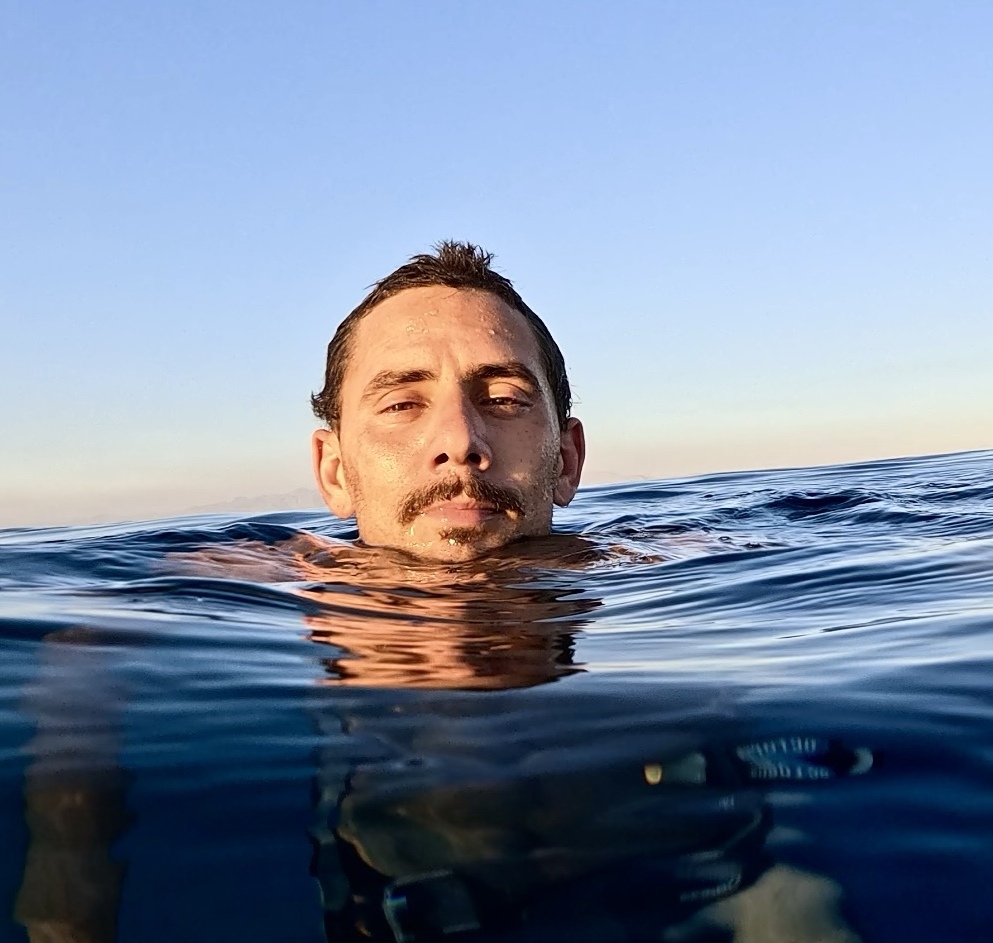
Every year in California, spearfishers die in shallow water from injuries that are almost entirely preventable. The fish weren't the problem. The depth wasn't the problem. The problem was the part of the dive nobody taught them — how to manage their own physiology underwater, and how to keep a buddy alive when something goes wrong.
AIDA is the international standards body for freediving. Its courses are built around exactly this gap. If you spearfish in San Diego and you've never taken one, you're missing the safety half of the sport.
What You're Actually Risking
Spearfishing fatalities almost never come from the obvious causes — shark, entanglement, equipment failure. They come from three physiological events that look minor right up until they're not:
Shallow Water Blackout (SWB)
You hold your breath past the urge to breathe. You hit the surface. Your body fails to draw the recovery breath in time and you lose consciousness — usually in the last 15 feet of ascent or within seconds of surfacing. SWB doesn't feel like anything. You don't get a warning. One moment you're swimming up; the next moment you're face-down in the kelp with no airway.
This is what hyperventilation before a dive sets you up for. The deep-breathing-up routine many spearos do — a dozen forced breaths before going down — is the single most dangerous habit in the sport. It blows off carbon dioxide, which is what triggers your urge to breathe. You lose your warning system. You can stay down longer, but you also can no longer feel the threshold where you're about to black out.
Loss of Motor Control (LMC) — "Samba"
A milder version of the same problem. You surface, you take a breath, you start to convulse: head tilts back, body shakes, mouth gapes. It usually resolves in 5–15 seconds. If you have a buddy holding your airway above water, you breathe through it and recover. If you're alone — or your buddy didn't see you surface — you breathe water and drown.
Hypoxic Surface Loss
The third one is sneakier: a delayed blackout that happens 30–60 seconds after surfacing, after a borderline dive. You come up, you feel fine, you start swimming back to the boat, and then the lights go out. This is why proper protocol is "wait 30 seconds at the surface before doing anything" — and why a buddy who watches you for that 30 seconds is the difference between an interesting story and an obituary.
What AIDA Training Actually Teaches
An AIDA course isn't about going deeper or holding your breath longer. Those things happen, but they're side effects. The core curriculum is risk management — the stuff that closes off the three failure modes above.
1. Breath-up Without Hyperventilation
You learn a calm, diaphragmatic breath-up that lowers heart rate without stripping your CO2. You stop blowing off your warning system. Your urge-to-breathe contractions come back at the correct depth and tell you when it's time to head up. This single skill probably prevents more blackouts than every other intervention combined.
2. One Up, One Down
The AIDA buddy protocol is non-negotiable: one diver is in the water on the line or watching from above; the other is making the dive. Nobody dives without a buddy. Nobody dives at the same time. Your buddy meets you at 30 feet on the ascent and watches you for 30 seconds at the surface. This sounds slow until you realize the alternative is the silent blackouts described above.
3. LMC and Blackout Rescue
You learn the standard "blow-tap-talk" protocol for a surface blackout, how to support an LMC victim's airway, how to bring an unconscious diver up from depth without dropping them. You practice it in the pool until it's reflex. If your buddy goes down, you don't have time to remember what to do — you do it.
4. Frenzel Equalization
Most spearos equalize using a hard Valsalva — clamping nose, blowing pressure into the ears through the chest. It works at shallow depth. At 40 feet and below, with the diaphragm pulling up against negative pressure, Valsalva starts to fail. Frenzel uses the tongue and soft palate to move air independently of the lungs. It works deeper, costs no air, and dramatically reduces ear and sinus barotrauma.
5. The 1:1 Surface Interval Rule
Every dive accumulates a small oxygen debt. AIDA teaches the surface-interval rule: rest at least as long as the dive lasted, and double that on dives near your limit. Most spearfishing days break this rule constantly — short surface, dive, short surface, dive — and the cumulative debt is why people blackout on dive #8 of the morning, not dive #1.
AIDA 2 Is the Standard
The relevant certification for a working spearo is the AIDA 2 Freediver course. The performance bar is reasonable for anyone already comfortable in the water:
- A 2-minute static breath hold
- A 40-meter pool swim on one breath
- A 12-meter (~39 ft) constant-weight ocean dive with proper buddy and recovery protocol
- A written exam on physiology, safety, and equipment
That's it. Most spearos hit those numbers in a 2.5–3 day course without serious prep. What you walk out with is the structured knowledge of why each protocol exists — not "because the instructor said so," but because here is exactly what happens in the body when you skip it.
The San Diego Context
La Jolla is a near-perfect spearfishing ecosystem. The kelp forests off the Marine Room and Boomer Beach hold legal lobster, white seabass when they're in, halibut, and the occasional yellowtail. The canyon edge drops to 35+ feet within a short swim of shore. Visibility runs 15–40 feet most of the year. The water is cold enough to keep crowds manageable and warm enough for a 5/3 wetsuit to be plenty.
All of which means your typical dive day involves repeated 25–35 foot dives over several hours, often solo or with a casual buddy, in kelp that obscures sight lines. This is exactly the environment where the SWB / LMC / surface-loss failure modes are most likely. Every spearo I know has a story about a buddy who came up wrong. The ones who knew what to do told a better story.
What the Course Day Looks Like
Day one is a pool session and theory. We work on relaxation, breath-up, static apnea, and rescue scenarios in chest-deep water. The 40-meter dynamic is more about technique than fitness — most spearos swim that far on the surface without thinking.
Day two and three are open water at La Jolla Shores. We use a buoy and a vertical line — you descend along the line head-first, work on equalization technique on the way down, turn at 12 meters, and ascend with a buddy on safety. By day three, most students hit 16–18 meters on the line without trying.
You walk away with an AIDA 2 card recognized by every freediving school in the world, the technical vocabulary to articulate what's happening in your body underwater, and — most importantly — the muscle memory to handle a buddy emergency without having to think.
After the Course: Saturday Sessions
The other piece worth mentioning is the LJFC Saturday Sessions. Once you're certified, you're welcome to join the group ocean session every Saturday morning at La Jolla Shores. Free with Ocean Flow membership, $25 drop-in. We set the mooring line at 35–40 feet, run safety rotations, and let everyone work on their own depth or technique. This is where spearos get to keep the freediving muscle memory sharp on the days they're not chasing fish.
The Bottom Line
The spearos who skip the training aren't wrong because the dives are too dangerous. They're wrong because the failure modes are silent. You don't get a near-miss to warn you. You either know what to do on the surface when your buddy comes up wrong, or you don't — and the difference is the AIDA course you took or didn't take.
Spearing brought you to the ocean. AIDA training keeps you in it.