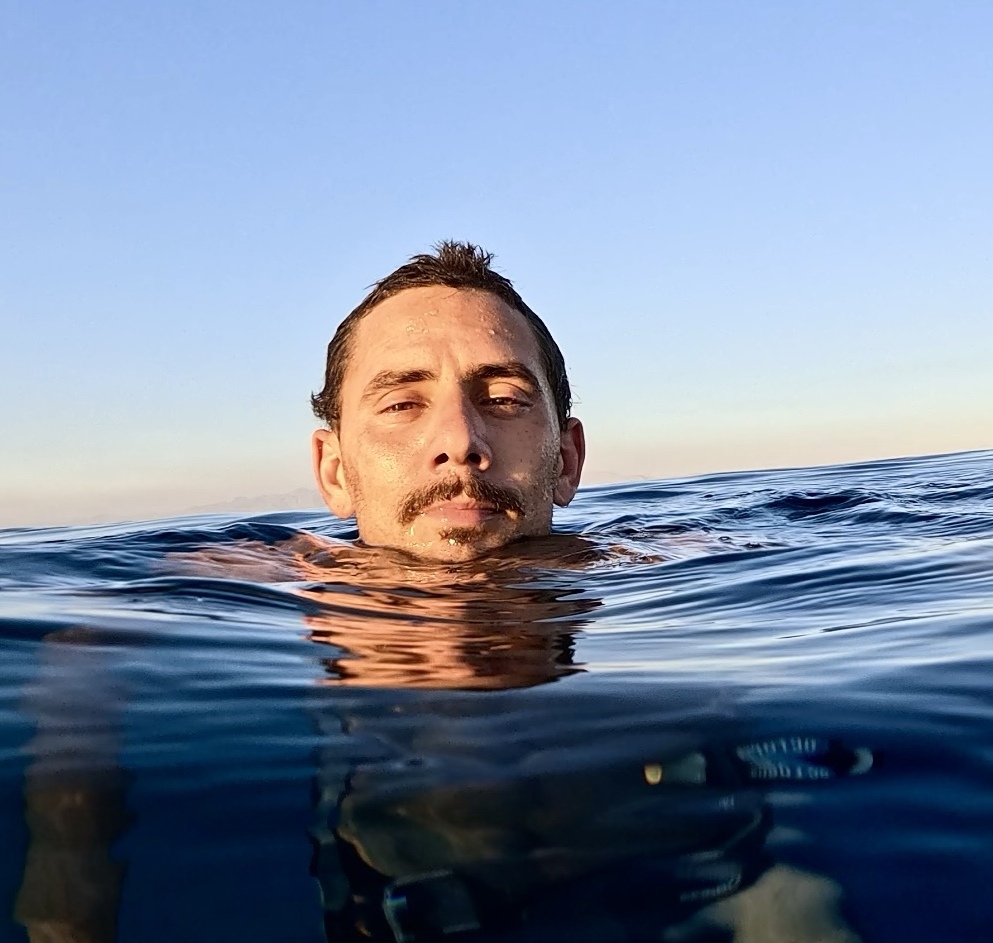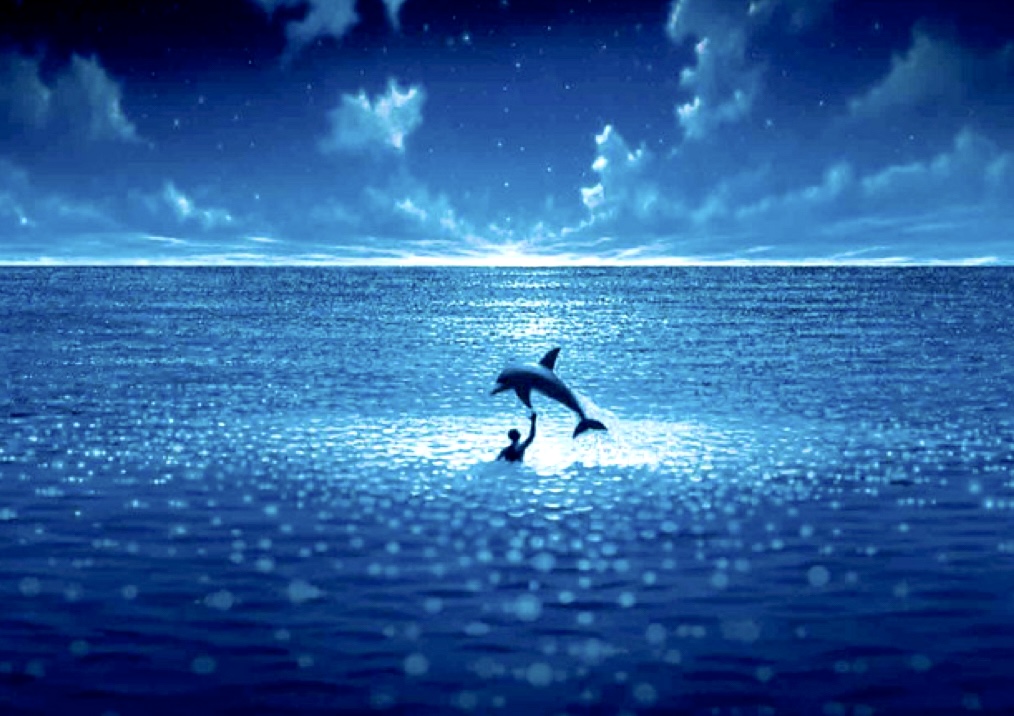
The film is a heavily fictionalized account of the real-life rivalry and friendship between two of the most important freedivers in history: Jacques Mayol and Enzo Maiorca. If you haven't seen it, watch it. If you have, watch it again. It hits differently once you've felt the pull of the deep yourself.

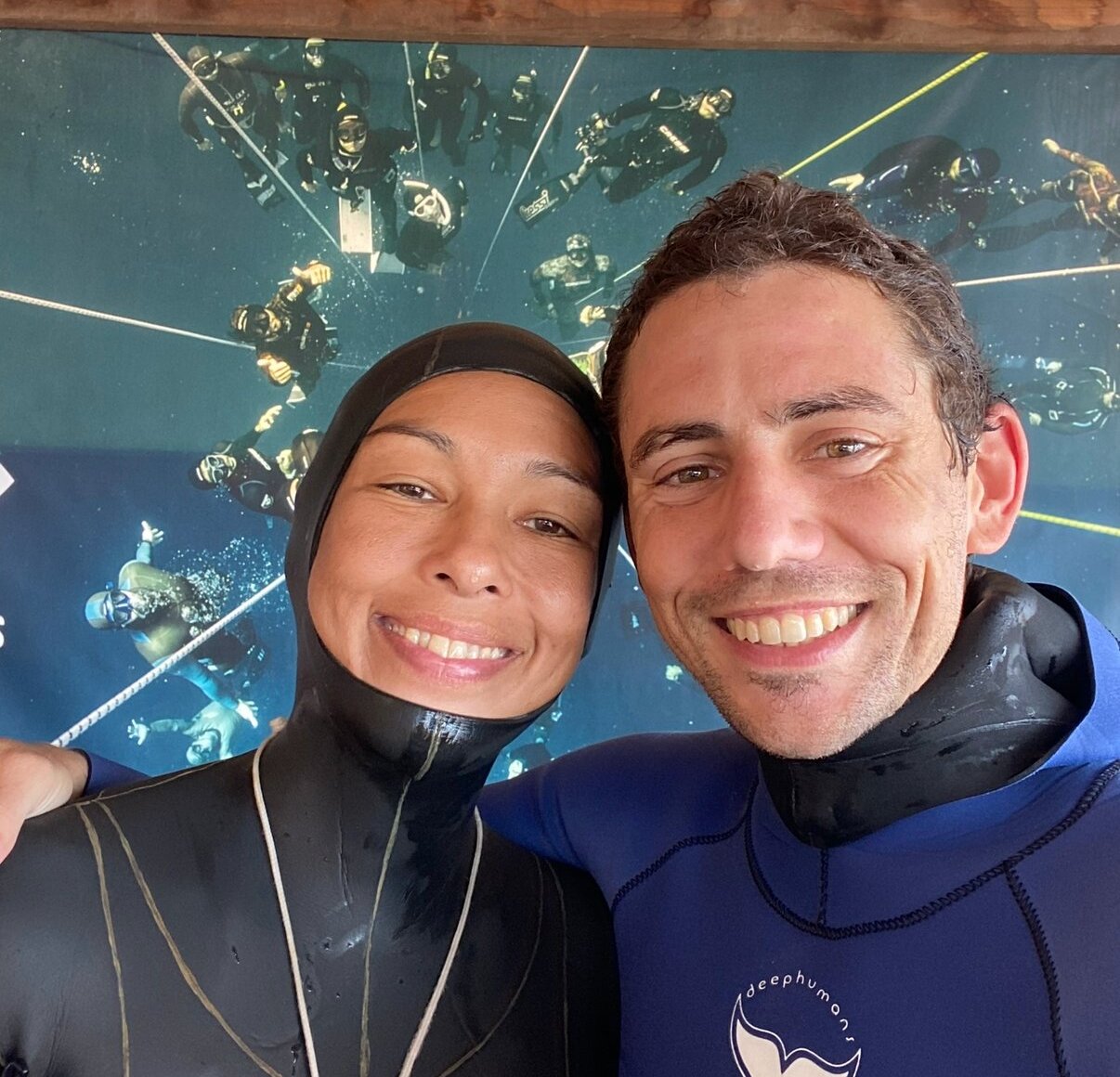
With Stella Abbas at the Blue Hole, Dahab — where The Big Blue's spirit lives on
The Real Story
Jacques Mayol was born in 1927 in Shanghai and spent childhood summers diving in the seas around Japan, where he first encountered dolphins. That encounter shaped his entire life. He went on to become the first human to freedive past 100 meters — a no-limits dive off the coast of Elba, Italy, in 1976. During the dive, his heart rate dropped from 60 to 27 beats per minute, demonstrating the mammalian dive reflex in a way that stunned the scientific community. He later wrote Homo Delphinus: The Dolphin Within Man, exploring his theory that humans retain dormant aquatic capabilities from our evolutionary past.
Enzo Maiorca, the Sicilian, was Mayol's counterpart — a record-breaking diver with a personality as big as his lungs. Both men pushed past 100 meters in the no-limits discipline, trading records back and forth across decades. In reality, they weren't direct competitors who faced off at the same events as the film portrays — their rivalry played out over years, through press coverage and word of mouth. But the competitive tension between them was real, and it drove both men deeper than anyone thought possible.
What Besson Got Right
Besson was a diver himself — the son of two dive instructors from Club Med. A diving accident forced him out of the water at 17, but the experience stayed with him. He first encountered Mayol through a French documentary and knew immediately he'd found the protagonist of a future film. Nearly a decade later, after the success of Subway, he began production. Mayol himself worked on the screenplay.
What Besson captured better than any film before or since is the interiority of freediving — the way it draws you inward before it takes you down. The film doesn't just show diving. It shows the meditative state that precedes it. The stillness. The withdrawal from the surface world. The way a freediver's attention narrows to breath, then to heartbeat, then to something quieter than both.
Jean-Marc Barr plays Mayol as someone who is more comfortable underwater than on land — someone who can't quite connect with the human world but who becomes completely alive in the ocean. It's a portrayal that every serious freediver recognizes. Not because we're all socially detached romantics, but because the film nails the feeling of being between two worlds — the one above the surface where you live, and the one below it where you feel most yourself.
Jean Reno's Enzo
If Barr's Jacques is the soul of the film, Jean Reno's Enzo is its heart. Reno plays Maiorca (renamed Molinari in the film — Maiorca objected to the portrayal for years) as a force of nature: loud, competitive, warm, fearless, and deeply loyal. Where Jacques is pulled to the deep by something mystical, Enzo is pulled by ego and love of the fight. He doesn't want to merge with the ocean — he wants to conquer it, to prove he's the greatest, and to do it alongside the one person who can match him.
The real Maiorca resented the caricature for a long time. He only softened his stance after Mayol's death in 2001. But Reno's performance gave the film something essential: warmth. Without Enzo, the film would be beautiful but cold. With him, it has a beating heart — someone who reminds us that diving isn't just about inner peace. It's also about the thrill, the competitive fire, the simple human desire to go further than anyone has gone before.
The Dolphin Question
Mayol's real-life obsession with dolphins runs through the film like a current. As a child, he dove with dolphins in Japan. As an adult working at an aquarium in Miami, he formed a bond with a dolphin named Clown that transformed his understanding of what the human body could do underwater. He studied how dolphins breathed, moved, and regulated their physiology — then applied those principles to his own diving.
His theory of "Homo Delphinus" — that humans carry dormant aquatic capabilities from our evolutionary past — anticipated much of what modern science has confirmed about the mammalian dive reflex. When you put your face in cold water and your heart rate drops, when blood shifts from your limbs to your core organs at depth, when your spleen contracts to release oxygen-rich red blood cells — these are the reflexes Mayol believed connected us to our aquatic ancestors.
The film doesn't explain the science. It shows it — through dream sequences where water fills Jacques' bedroom, through the way he moves underwater with an ease that seems inhuman, through the dolphins that appear at the edges of the story like guides to another world.
The Ending
The European version of The Big Blue has one of the most haunting endings in cinema. After Enzo's death attempting to break Jacques' record, Jacques descends into the deep one final time, releases his safety harness, and follows a dolphin into the darkness — leaving a pregnant Johana on the surface.
The American distributor demanded a different ending — one where Jacques returns to the surface — because test audiences found the original too bleak. If you've only seen the American version, find the European cut. The original ending is devastating but essential. It captures something true about the relationship between obsession and self-destruction, between the beauty of going deeper and the danger of not knowing when to stop.
This is one of the reasons safety is so central to everything we do at La Jolla Freedive Club. The romance of the deep is real — anyone who's felt freefall at 20 meters knows the pull. But the film shows where that romance leads without training, without buddies, without the discipline to surface when your body says go deeper. Freediving is extraordinary precisely because it requires you to override the call. To breathe. To come back up. To live on the surface so you can dive again tomorrow.
Why It Still Matters
The Big Blue was released in 1988, before freediving had any mainstream visibility. There were no AIDA courses, no Molchanovs education system, no Instagram reels of people diving to 100 meters. The film introduced millions of people to a world most had never imagined — that humans could go that deep on a single breath, that there was an entire subculture built around it, and that the ocean held something worth leaving the surface for.
The Eric Serra soundtrack — ethereal, electronic, hauntingly simple — became synonymous with the underwater world. The cinematography, shot in locations across the Greek islands, Sicily, the Peruvian Andes, and the French Riviera, set a visual standard for ocean filmmaking that still holds up nearly four decades later.
But more than anything, the film captured a feeling. That moment when the noise stops. When the surface recedes. When the blue gets bigger and the world gets smaller and you realize you're not holding your breath anymore — you're just... there. In it. Part of it.
Every freediver knows that feeling. Besson put it on screen.
Watch It
If you're thinking about learning to freedive, watch The Big Blue first. Not because it's accurate (it's not — neither Mayol nor Maiorca reached the 122 meters depicted in the film). Not because it teaches technique (it doesn't). But because it captures the why. The reason people keep going back to the water. The thing that makes you sign up for a course, drive to the coast at 6am on a Saturday, and swim 500 meters out to a mooring line to spend an hour going up and down a rope.
It's not rational. It's not practical. It's the big blue.
Le Grand Bleu is available on most streaming platforms. We recommend the 168-minute European director's cut — the version Besson intended.