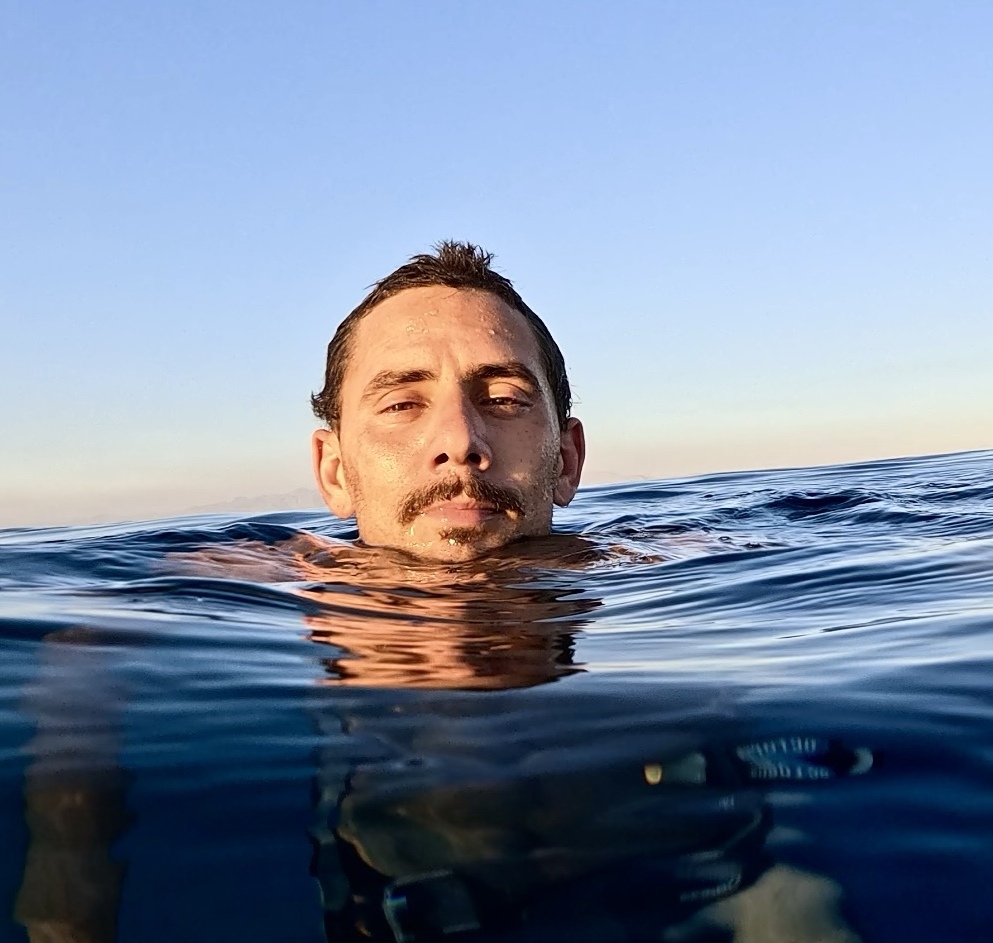
That kind of relationship with the ocean isn't something most kids develop on their own. It's certainly not something you get from a typical swim lesson, where the goal is reasonably "don't drown" and the metric is laps completed. And it's not what surf camp delivers either — surf camp is great, but it's about the board, the wave, and the pop-up. The water itself stays mostly external.
Camp Garibaldi is built around a different premise: that the most useful, durable, and joyful skill a kid can develop in the ocean is comfort holding their breath underwater. Not because they'll become competitive freedivers — almost none of them will. Because that comfort changes everything else.
What "Breath-First" Actually Means
Freediving is the entry point. The full sport — depth, lines, equalization technique — is for adults. But the foundational layer of freediving is something every kid can learn safely and benefit from for the rest of their life: knowing that you can hold your breath calmly underwater, and that the urge to breathe is a sensation you can sit with rather than panic at.
That foundation does several things at once:
- Removes the panic response. A kid who has practiced holding their breath in a calm pool doesn't flail when a wave knocks them over. They stay relaxed, wait it out, and surface when they're ready.
- Builds water reading. Kids who can submerge comfortably learn to read what the ocean is doing below the surface — currents, surge, kelp lanes — instead of just reacting to chop.
- Develops genuine respect. The ocean stops being a generic "scary thing" and becomes a specific environment with rules. Respect built on understanding holds; respect built on fear evaporates the moment a kid stops being afraid.
- Cross-applies everywhere. Surf survival, body surfing, snorkeling, lifeguarding later, scuba later, even competitive swimming — all of them get easier and safer for a kid who's done breath-first work.
The Three Levels: Bronze, Silver, Gold Dolphin
Camp Garibaldi is staged by readiness, not strictly by age. The three Dolphin levels follow the AIDA Youth standard and are designed so a 7-year-old who's a strong swimmer can sit in the same group as an 11-year-old who's just learning to put their face in the water.
Bronze Dolphin (typical age 6–9)
The point of Bronze is the foundation: face in the water without flinching, eyes open underwater, basic snorkel clearing, a short calm breath hold, and the games that teach buddy awareness. Most of the day is play — but play with a purpose. Kids leave Bronze knowing that holding their breath underwater is fun, not scary.
Silver Dolphin (typical age 8–12)
Silver introduces light freediving mechanics. Duck dives, equalization basics (the gentle ear pinch and blow), short downward swims to grab a target weight off the bottom of the pool, surface protocols. We start using the word "buddy" in its real freediving sense — one person watches while the other goes under. Static apnea up to a minute or so, on land or in the pool, treated as a relaxation exercise rather than a competition.
Gold Dolphin (typical age 11–14)
Gold is the bridge to actual freediving. Kids work on Frenzel equalization, longer dynamic swims, deeper duck dives, and start to do real ocean work — but in the kid version: a 3–4 meter ocean dive in chest-deep water at La Jolla Shores, with a coach on safety. The point isn't depth. The point is doing it correctly: relaxed breath-up, calm descent, good equalization, proper recovery.
AIDA Junior (ages 12–15)
For the older end of the camp — and for kids who finish Gold and want to keep going — there's the AIDA Junior course. This is structurally close to the adult AIDA program: pool sessions, theory, a written exam, and supervised ocean dives. The standards are scaled for the age group but the rigor is the same. At 16, an AIDA Junior graduate is eligible to take the full adult AIDA 2 course.
What This Looks Like in Practice
A Camp Garibaldi week runs five days at La Jolla Shores and the pool. Each day has the same rhythm:
Morning land session. A short warm-up — stretching and breathing drills, no yoga vocabulary, just the practical mechanics of slowing the breath down. We talk about what's coming, what we're working on, and answer the question every kid asks at some point: "Why doesn't my body want me to do this?"
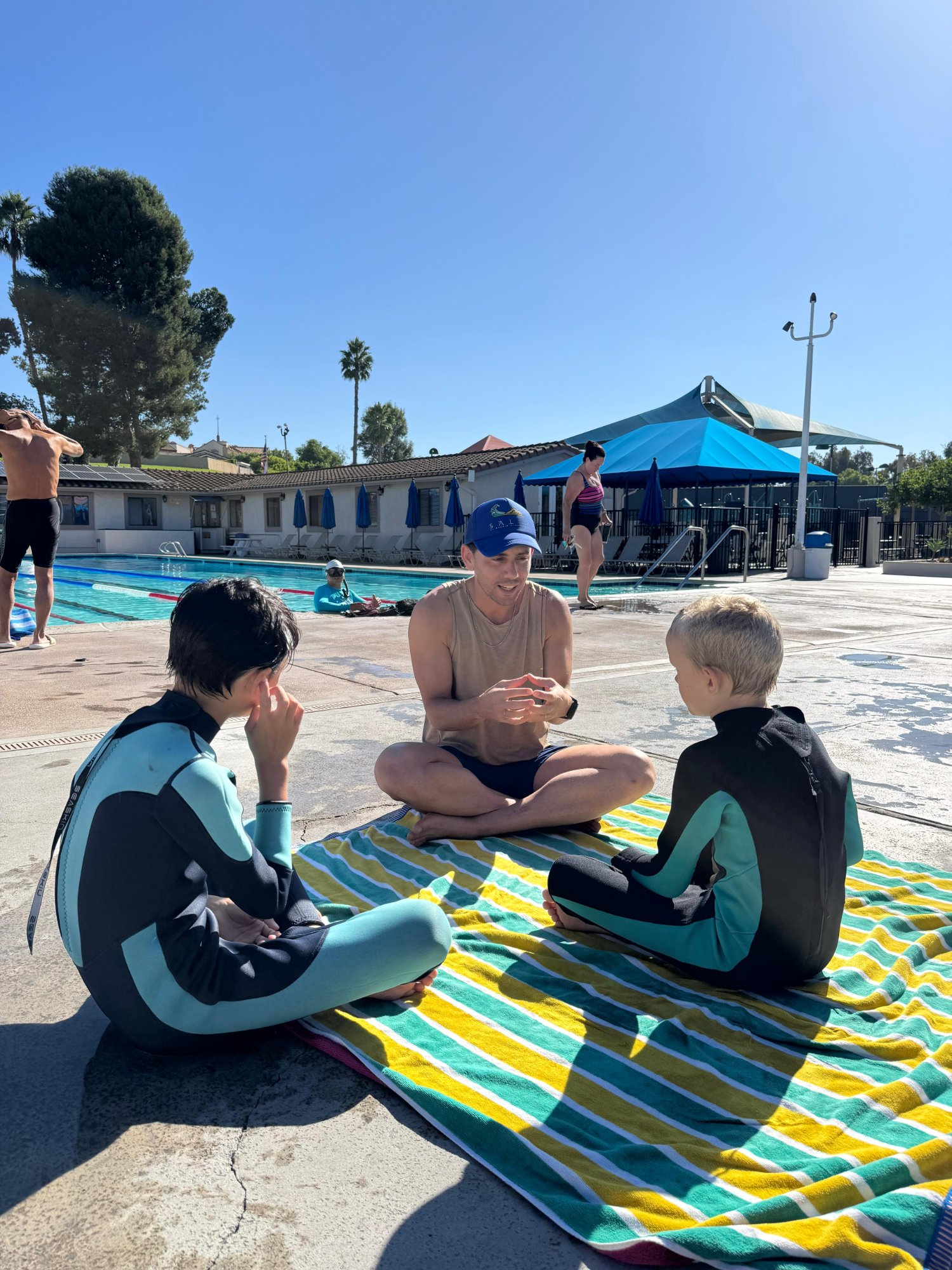
Pool block. Goggles on, masks on, snorkels in. Games that secretly teach: who can sit longest at the bottom of the pool relaxed, who can pick up the most weights on one breath, who can pass an object to a buddy underwater without missing the handoff. Skill drills disguised as fun.
Lunch and surface time. Snacks, hydration, and a quick story from somewhere in freediving history — Jacques Mayol, Audrey Mestre, the AIDA Worlds. Kids are sponges for context. They retain the technique better when they know why anyone bothered to develop it.
Ocean session. Suits on, walk to the water, group entry through the surf zone. The ocean part of camp is the part most parents are nervous about and most kids end up loving. We work in chest-to-shoulder-deep water for Bronze and Silver, slightly deeper for Gold, always with the coach in the water and never outside line of sight.
Closing. Quick debrief, what we learned, what to work on tomorrow. Kids tell each other their best moment of the day. Then home.
What Parents Should Know About Safety
The honest answer to "is this safe for my kid?" is: yes, when it's run to the standards Camp Garibaldi is built on. Here's what those standards look like in practice:
- AIDA Youth Instructor certification. The Youth Instructor course is a separate AIDA credential beyond the adult Instructor cert. It covers child physiology, age-appropriate exposure progression, communication, and the specific risk profile of teaching kids underwater. Joshua holds both.
- Ratios. AIDA standards require a 4:1 student-to-instructor ratio in open water, with assistant support for larger groups. Camp Garibaldi runs lower ratios than the requirement — typically 3:1 in water — because kids need more direct visual contact than adults.
- Never out of sight. Every kid in the water is in the line of sight of a coach or assistant at all times. There's no "let them play and check back in 10 minutes." The supervision is continuous.
- First aid and CPR on site. The instructor team carries current Red Cross Adult & Pediatric First Aid/CPR/AED, plus DAN Professional Liability Insurance for the in-water work.
- Medical screening up front. Before camp starts, every family completes a youth medical statement. Any flag — asthma, ear issues, recent surgery — gets a conversation, sometimes a physician sign-off, sometimes a modification to the kid's program. We don't surprise anyone with a problem on day three.
- No hyperventilation, ever. The single most important safety rule in freediving is also the single most important rule at Camp Garibaldi. Kids are taught a calm, two-minute breath-up. They are explicitly told that "deep breaths fast before going under" is the wrong way and shown why.
Why La Jolla Is the Right Setting
La Jolla Shores is one of the most forgiving ocean training environments in California. The beach is sand, gradual, and protected on three sides by the kelp and the canyon walls. The surf at the Shores section is small most days, often ankle-to-knee high, breaking gently over a sandy bottom. Visibility is good. Water temperature is moderate. The lifeguard tower is staffed and within sight of where camp runs.
And the marine life is the secret weapon. Kids who learn to freedive in a tide-pool environment care about tide pools the rest of their lives. Kids who learn at La Jolla — among the leopard sharks, garibaldi (yes, the camp is named after the fish), bat rays, and seasonal sea lions — develop a relationship with that specific ecosystem that doesn't go away.
What Kids Take Home
The literal souvenirs are small: a certificate, a stamped logbook, maybe a Camp Garibaldi sticker. The actual takeaway is harder to measure but easier to see in the water.
Parents who've sent kids to camp tell us the same thing: their kid swims differently afterward. Calmer in the surf zone. Goes deeper when snorkeling without making a thing of it. Holds their breath underwater on the way to grab a sand dollar without surfacing in a panic. Treats the ocean like a friend they know rather than a stranger.
That's the goal. Not a future world-record freediver. A kid who is at home in the water for the rest of their life.
How to Sign Up
Camp Garibaldi runs in week-long sessions throughout the summer at La Jolla Shores. See camp dates and details, or reach out via the camp inquiry form with your kid's age, swim background, and any medical context. We respond within 24 hours and can usually fit families into the session that works for their summer.