Before I ever held my breath underwater, I spent six months holding it on land.
Not literally. But in the Thai forest monasteries where I lived before I found freediving, the practice was structurally identical: sit still, focus on one thing, and watch what your mind does when the discomfort arrives. In the Theravada tradition, they call the focal object a kammaṭṭhāna — literally “place of work.” It could be the breath, a body sensation, a color, a sound. The point wasn't the object itself. The point was what the object did to the architecture of your attention.
I didn't know it at the time, but I was training for freediving.
We say it's 80% mental.
We train 90% physical.
Ask any freediver why they started and the answers cluster around the same territory: peace, quiet, transformation, escape. The water delivers. Every time. It's a perfect mirror — it shows you exactly what's happening in your body and your mind, whether you asked to see it or not.
But here's what most freediving education doesn't address directly: the states of consciousness that drew us to the sport — the calm, the dissociation from surface noise, the feeling of being fully present — those states are treated as byproducts of technique rather than skills to be trained.
In a typical 20+ hour AIDA course, we spend maybe one to two hours on the mental side. The rest is equalization mechanics, Boyle's Law, safety protocols, technique drills. All essential. But the ratio is inverted relative to what actually determines performance.
This creates a gap. Students finish certification with solid technique but without systematic tools for accessing the psychological states that make the technique work. So they have good days and bad days. They can't figure out why Tuesday's dive felt effortless and Thursday's felt like a fight.
People burn out not because their bodies failed them but because their minds did, and nobody gave them tools to address it.
Where the time goes in a 20-hour course
The ratio is inverted relative to what determines performance.
What if it's 100% mental?
Every “physical” skill in freediving has a cognitive layer that determines whether it works.
Umberto Pelizzari admitted that early in his career, he focused intensely on physical training, only later realizing that the mental component was crucial. Research on elite freedivers shows a fivefold increase in sympathetic nerve activity during deep dives — the fight-or-flight system screaming — while maintaining stability that would overwhelm an untrained person.
That's not their bodies automatically handling the stress. That's a trained psychological capacity to coexist with signals that evolution designed to make you panic.
“We're teaching people to override millions of years of survival instincts in a weekend course.
What happens in elite freedivers' brains
Research during optimal breath-holds shows a sharp increase in alpha wave activity — the frequency band associated with being simultaneously calm and alert. Some brain areas activate while others quiet down, in a pattern neuroimaging studies describe as bearing “striking similarity with observations during mindfulness and Vipassana meditation.”
This is not a metaphor. Elite freedivers and advanced meditators are registering functionally similar brain states through different doorways.
Swedish freediver Ulf Dextegen achieved an 8:43 static breath-hold — a national record — using primarily mental techniques. He started at 40, from a desk job, with no athletic background. Within a year, his brain had learned the state pattern so well he didn't need the trigger cue anymore. The shortcut had become the default.
That's neuroplasticity. What wires together, fires together. And it works in both directions — you can train your brain toward performance states just as reliably as you can train your body toward physical ones.
Boyle's Law and the Transcendental Meditation diagram
I had an epiphany during my AIDA instructor course. Everyone knows the Boyle's Law diagram: depth, pressure, gas volume. In Transcendental Meditation, they use a nearly identical diagram for states of consciousness. At the surface, full-volume mental activity. As you settle deeper, thought becomes subtler. The mental “bubble” gets smaller and quieter.
In one case, the medium is air and the mechanism is hydrostatic pressure. In the other, the medium is attention and the mechanism is focused repetition. But the shape is identical: descent compresses. The deeper you go — physically or psychologically — the more concentrated and refined the experience becomes.
In TM, the tool that carries you down is a mantra — a single repeated sound. It functions as an anchor. You don't analyze it. You repeat it, and the repetition itself creates the descent. The mantra is the weight on the line.
“The water is the meditation hall. The descent is the mantra. The anchor is whatever brings you home.
State anchors: making the invisible visible
A state anchor is a cognitive cue — auditory, visual, or somatic — that you train to reliably trigger a specific psychological state.
Through daily conditioning, you pair the cue with the desired state until the neural pathway becomes automatic. What might initially require 30 minutes of progressive relaxation becomes accessible in 30 seconds through a trained trigger.
This isn't a new idea. It's the oldest idea. What I call state anchors, Buddhist practitioners have called kammaṭṭhāna for 2,500 years. What sports psychologists call visualization cues, contemplative traditions call upāya — skillful means. The mechanism is neuroplasticity. The application is performance. The lineage is ancient.
Traditional visualization focuses on what to do — rehearsing the dive. State anchoring focuses on who to be — accessing a quality of consciousness that makes the procedural stuff work better. It's the layer underneath.
Three pathways to anchor discovery
Taught Anchors
Proven techniques with established effectiveness. Someone hands you the tool and you practice it.
Similar to ānāpānasati used in monastery practice.
30 minutes of relaxation
→ 30 seconds
You identify an anchor that resonates. You begin a daily conditioning practice: five to ten minutes, same time each day. The neural pathway between the cue and the state gets stronger and faster with each repetition.
Now imagine you're at the beach on a Saturday morning. You didn't sleep well. Work stress is lingering. The conditions are marginal. Six months ago, this would have produced a bad dive day — anxiety at the surface, tension on the descent, fighting the urge to breathe instead of releasing into it.
But you've spent the last year conditioning a state anchor. You close your eyes at the buoy, invoke your cue, and within 30 seconds you're in the same psychological state that used to require a perfect morning and 30 minutes of preparation. That's the practical promise: reliable access to your optimal performance state regardless of external conditions.
The anchor doesn't care about context
State anchoring develops metacognition — awareness of your own mental states and the ability to modulate them. Once you can notice “I'm in an anxious state” and have a trained tool to shift toward “I'm in an alert-but-calm state,” you have something that applies to every stressful situation in your life. Job interviews, difficult conversations, medical procedures, parenting moments where you need to stay composed.
There's a healing dimension too. The dissociation during deep breath-holds is structurally similar to what happens during trauma — the mind creating space between awareness and sensation. But in freediving, you're training this dissociation consciously and voluntarily, in a controlled environment. Through state anchoring, you build positive neural entrainment patterns that gradually override destructive ones. You're not just training to dive better. You're restructuring how your nervous system responds to stress.
What this means for how we teach
Pre-course module on state anchoring sent two weeks before arrival
Structured guided sessions for anchor discovery during certification
Post-course practice framework students continue developing for life
“Freediving isn't an extreme sport. It's a consciousness conditioning practice that happens to take place in the ocean.
Find your anchor
Something auditory, visual, or somatic that personally resonates. Give yourself five to ten minutes a day, at a consistent time, for at least a week. Track what you notice — in the water and in your daily life. Share what you find with your dive partner, your instructor, your community.
The most powerful thing about this practice is that it honors individual differences. What works for me won't work for you. The anaconda that puts one diver into an altered state means nothing to someone else. The mantra that carried me through monastery sits and through breath-holds at the canyon rim is just a sound to anyone who hasn't lived inside it. That's the point. The anchor has to be yours.
But the method — the systematic conditioning, the daily practice, the neuroplastic pathway from cue to state — that's universal. And it's been universal for a very long time. Long before anyone called it freediving.
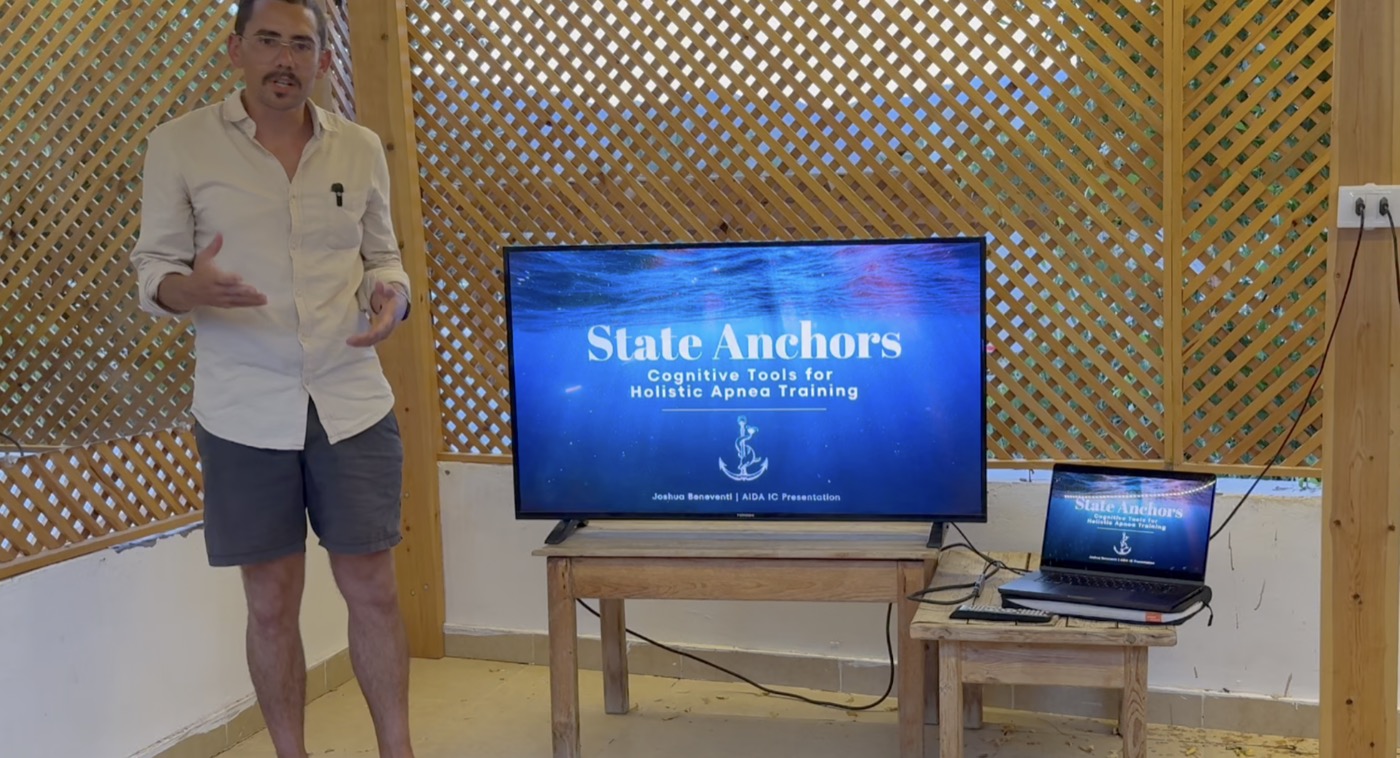
Presenting State Anchors during the AIDA Instructor Course, Dahab, Egypt
This post is adapted from “State Anchors: Cognitive Tools for Holistic Apnea Training,” a presentation given during my AIDA Instructor Course in Dahab, Egypt, with my first teacher Stella Abbas and my instructor trainer Khaled El Gammal both in the room. The 40-page research paper behind it is available on request.
Joshua Beneventi is the founder of La Jolla Freedive Club and San Diego's only AIDA-certified freediving instructor for adults and children. He is an AIDA 4 Freediver, UCSD alumnus, and spent six months living in Theravada Buddhist monasteries in Thailand before finding freediving. He teaches every Saturday at La Jolla Shores.
Ready to go deeper?
Join the LJFC community for courses, dive schedules, and consciousness conditioning workshops.
Get on the List →