What is AIDA?
AIDA stands for the International Association for the Development of Apnea. They've been the global authority in freediving education, safety standards, and competition since 1992. Unlike commercial dive agencies, AIDA is a nonprofit run by freedivers for freedivers. Their certification system is progressive — each level builds on the previous one in both technical skill and physiological understanding.
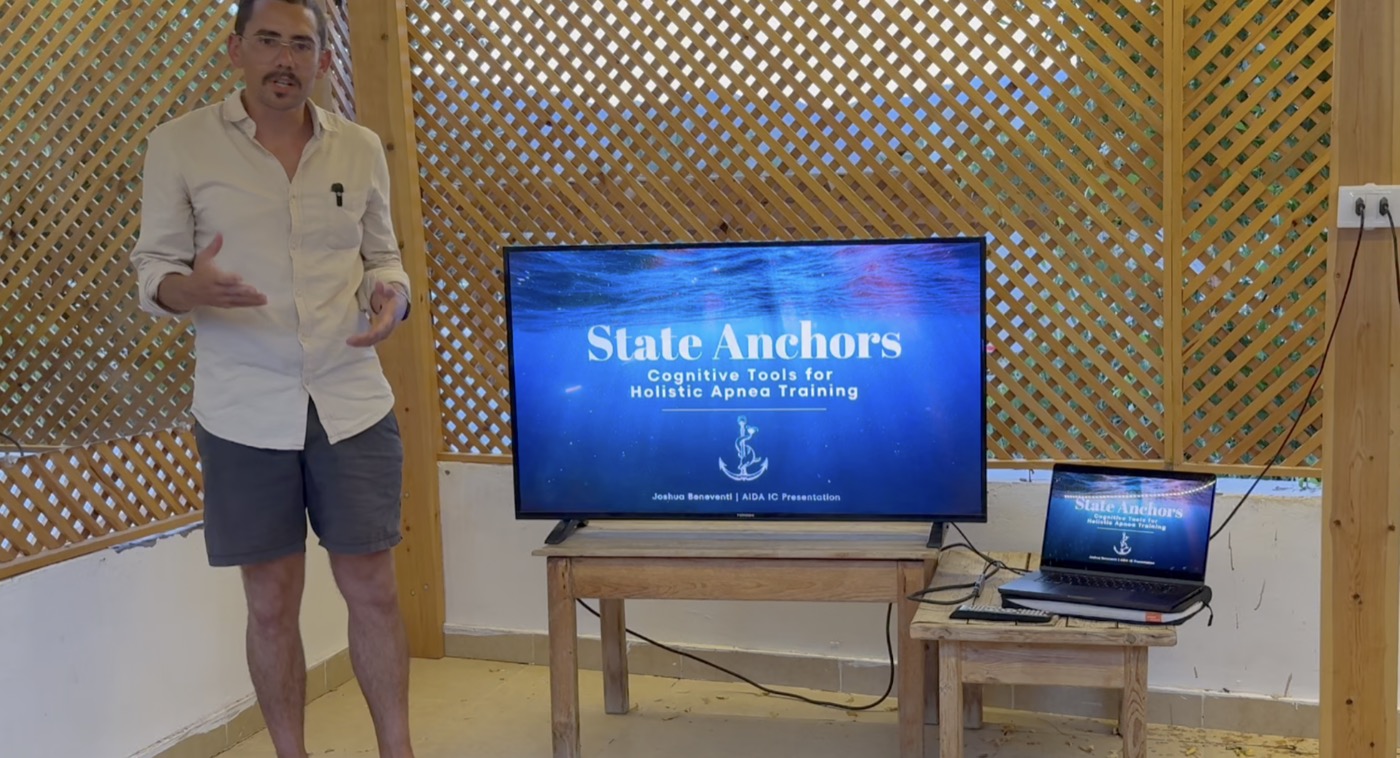
AIDA Instructor Course, Dahab, Egypt
Swimthrough training in Dahab
AIDA 1 — Introduction to Freediving
Duration: 1 day (3–6 hours) · Max depth: 10m · Prerequisites: Swim 100m non-stop
AIDA 1 is a one-day introduction for people who want to test the water — literally — before committing to a full certification. You'll learn basic relaxation techniques, try your first static breath holds, practice finning and duck dives, and learn buddy safety fundamentals.
There are no performance minimums. You earn the certification by demonstrating correct technique, relaxation, and safe behavior. It's designed to give you a solid foundation and help you decide whether to continue to AIDA 2.
Start with AIDA 1 if: You're completely new to freediving, you want a gentle one-day introduction, or you've never used fins, equalized, or practiced breathing drills.
AIDA 2 — Freediver Certification
Duration: 2.5 days minimum · Max depth: 20m · Prerequisites: Swim 200m non-stop (or 300m with fins/snorkel)
This is the first full certification level and the most popular course we run. AIDA 2 is where freediving gets real — you'll cover theory, pool disciplines, and open water depth diving over multiple days.
The certification requirements are specific:
- Static apnea (STA): 2:00 minute breath hold
- Dynamic apnea (DYNB): 40m horizontal underwater swim with bi-fins
- Constant weight (CWTB): 12–20m depth dive
- Theory exam: 75% minimum
You'll also learn rescue from 5–10m (both blackout and loss of motor control scenarios), equalization technique, proper weighting, and the buddy protocols that make freediving safe.
The course format includes at least 2 classroom sessions, 2 confined water (pool) sessions, and 3 open water sessions across 2 days. Instructor ratios are 8:1 in the pool and 4:1 in open water.
Start with AIDA 2 if: You're a strong swimmer, comfortable in open water, and want an internationally recognized certification. Prior snorkeling, diving, or breath-hold experience helps but isn't required.
AIDA 3 — Advanced Freediver
Duration: 3 days minimum · Max depth: 30m · Prerequisites: AIDA 2 certification (or crossover from SSI, PADI, Molchanovs)
AIDA 3 is where the training gets deeper — in every sense. This course is about developing real autonomy: the ability to plan your own training, manage your own safety, and dive beyond 20 meters with precision and control.
The certification standards step up significantly:
- Static apnea (STA): 2:45 minute breath hold
- Dynamic apnea (DYNB): 55m horizontal underwater swim
- Constant weight (CWTB): 24m depth dive
- Theory exam: 75% minimum
New skills include advanced Frenzel equalization (the technique that makes depth beyond 20m possible), free-fall technique, CO₂ and O₂ tolerance tables, deep-water rescue protocols, and a much deeper understanding of physiology — barotrauma, lung function under pressure, blood shift, decompression theory.
Lanyards are required beyond 20m in this course. The format includes 3+ hours of theory, 2 confined water sessions, and 4 open water sessions over 2 days.
Take AIDA 3 if: You're AIDA 2 certified and want to dive deeper, train smarter, or are considering the competition or instructor path.
AIDA 4 — Master Freediver
Max depth: 38m+ · Prerequisites: AIDA 3 certification
AIDA 4 is for experienced divers considering the instructor or competition track. It covers depth diving beyond 30m, mouthfill equalization, advanced physiology, and detailed risk mitigation. Not all schools offer AIDA 4 — it requires specific facilities and conditions. It's the prerequisite for the AIDA Instructor Course.
How the levels compare
Here's the full picture in numbers:
- AIDA 1: 1 day, 10m max, no performance minimums
- AIDA 2: 2.5 days, 20m max, STA 2:00 / DYN 40m / depth 12–20m
- AIDA 3: 3 days, 30m max, STA 2:45 / DYN 55m / depth 24m
- AIDA 4: 38m+, mouthfill equalization, instructor prerequisite
Each level roughly doubles the time investment and adds 10m of depth capability. The jump from AIDA 2 to AIDA 3 is the biggest in terms of physiological knowledge and technical skill.
What about crossovers?
If you hold a certification from another agency — SSI, PADI, Molchanovs, etc. — you can do a crossover evaluation instead of repeating the full course. This involves demonstrating that your existing skills meet AIDA standards at the equivalent level. We run crossover evaluations on a case-by-case basis.
Where to start in La Jolla
Most people who come through our door start with AIDA 2 — it's the sweet spot of commitment and payoff. You walk away with an internationally recognized certification, the skills to dive to 20m safely, and a community of divers to practice with every Saturday.
If you're on the fence, AIDA 1 is a low-commitment way to find out if freediving clicks for you. And if you're already certified and want to go deeper, our AIDA 3 course runs on demand based on interest.